Página 10 de 12

Urbanismo ‘Bypass’: Reordenar las relaciones centro-periferia en Calcuta, Lagos y la ciudad de México

Environment and Planning A – 2021

(resumen en ingles)

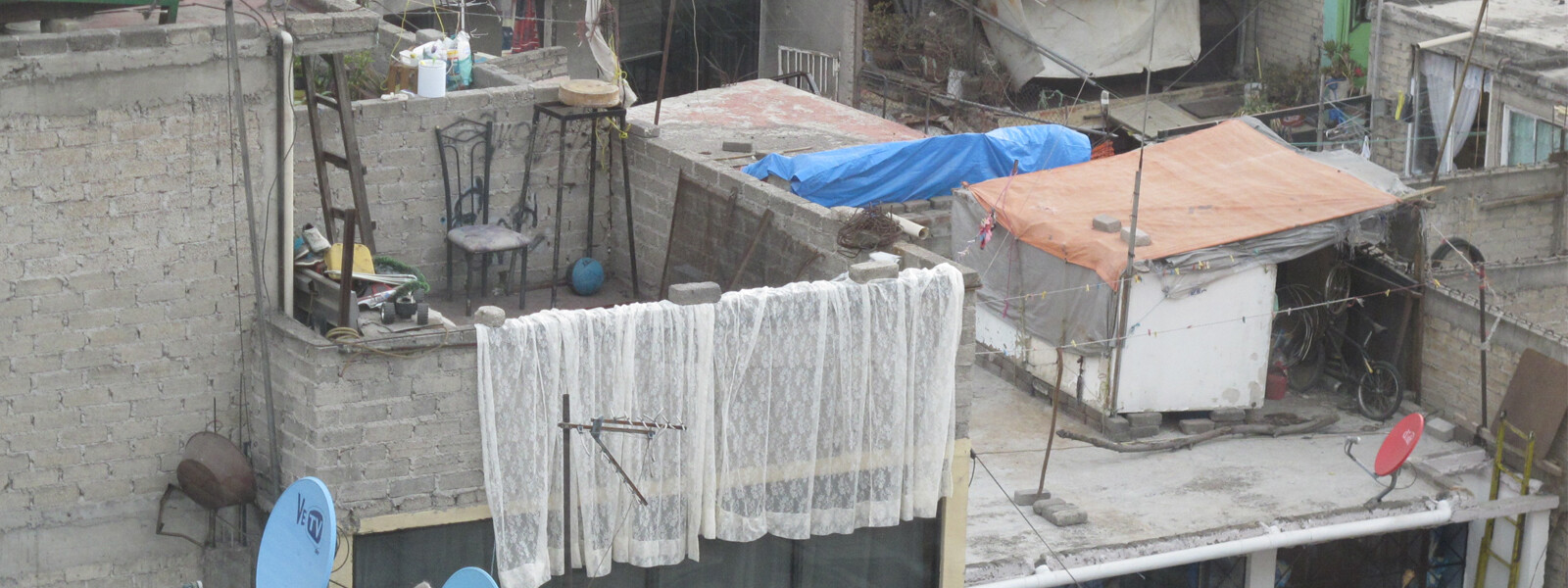
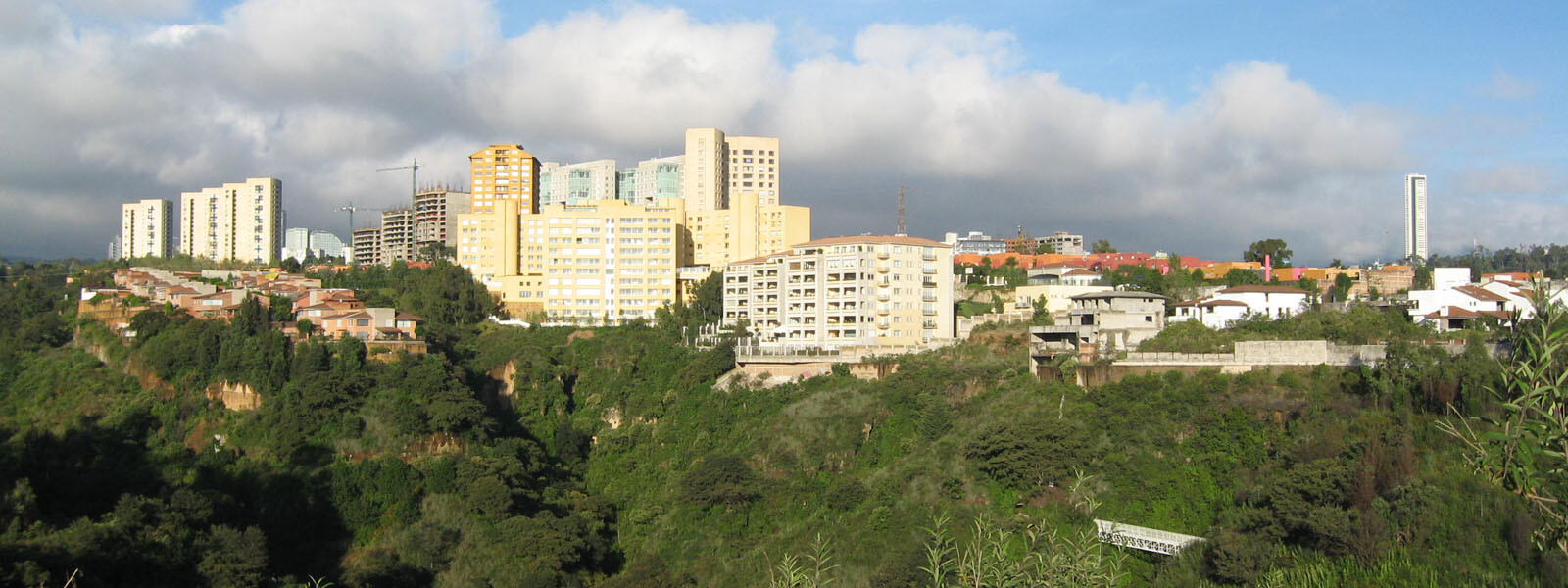
This paper introduces the concept of “bypass urbanism” to account for a process of urbanization that is reordering center-periphery relations of urban regions into new hierarchies. Bypass urbanism became visible through a comparison of large-scale urban transformations at the peripheries of Kolkata, Lagos, and Mexico City by zooming out and considering their impacts on the socio-spatial structure of the extended urban regions.

Bypass urbanism is not emerging from the construction of a singular new town or real estate project, but is the result of the simultaneous development of an ensemble of various independent but related projects. Therefore, bypass urbanism usually does not emanate from a coherent planning initiative, even less so from a hidden “master plan” at the hands of any single developer or state agency, but it emerges through a convergence of interests over large areas of land at the geographical periphery of urban regions that have been made available for new urban developments by various measures.

We understand bypass urbanism as a multidimensional process that includes material-geographical bypassing, the bypassing of regulatory frameworks, and socio-economic bypassing in everyday life. It results in the creation of exclusive and excluding spaces that enable middle and upper-class lifestyles, at the same time leading to the peripheralization of extant urban areas that are bypassed and neglected. The massive scale of bypass urbanism that we have observed represents a new quality of urban development resulting not in isolated urban enclaves or archipelagos, but in the fundamental restructuring of the extended urban region with far reaching and incalculable repercussions.

Sawyer, Lindsay, Schmid, Christian, Streule, Monika, Kallenberger, Pascal (2021) Bypass urbanism: Re-ordering center-periphery relations in Kolkata, Lagos and Mexico City. Environment and Planning A: Economy and Space 53.4, 675–703. DOI: 10.1177/0308518X20983818

Leer artículo

Territorios urbanos y conocimientos de otro modo. Construcción de conceptos etnográficos para una teoría más global

Descolonizando la Planificación en América Latina – 2020

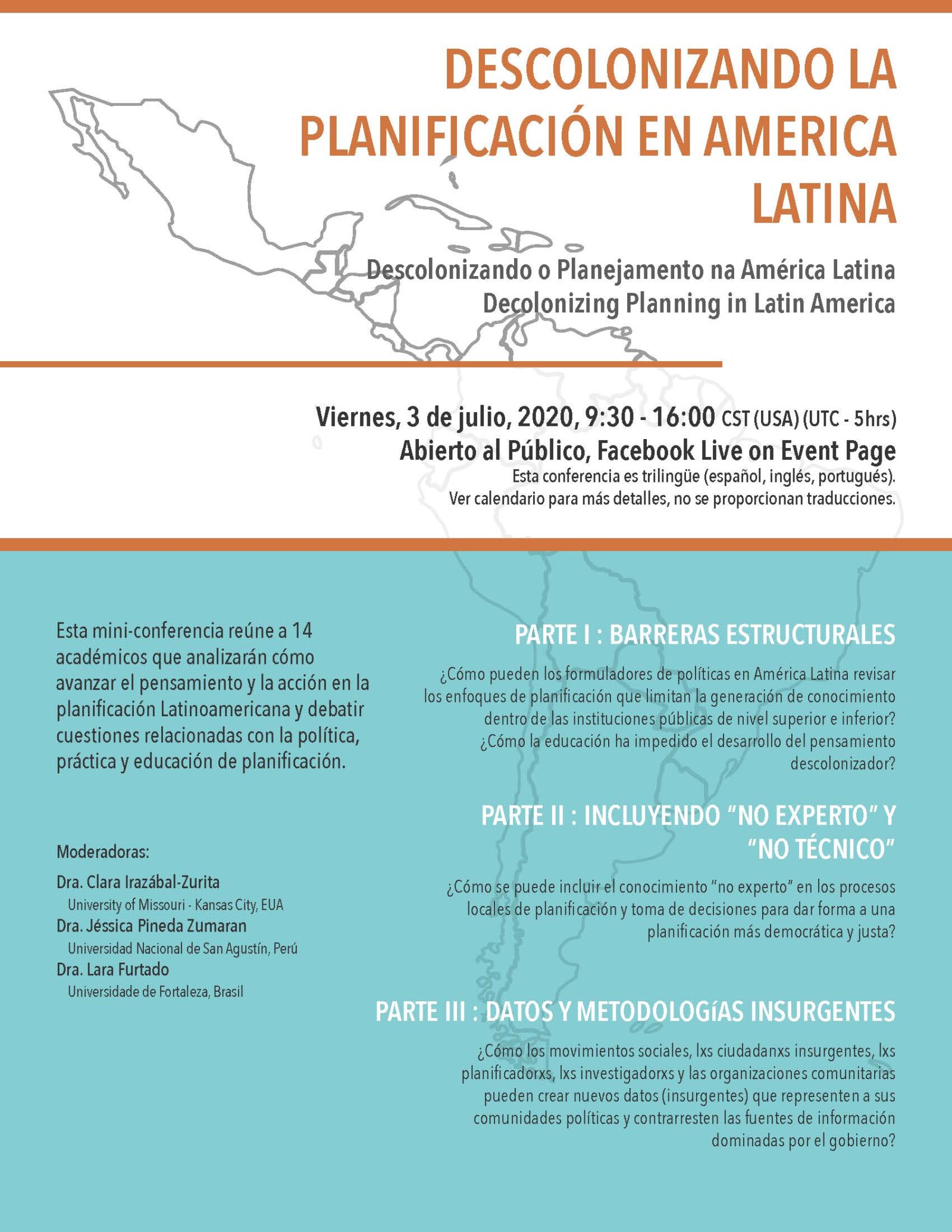
Ponencia en el marco de la conferencia virtual Descolonizando la Planificación en América Latina Parte II: Incluyendo saberes ‘no experto’ y ‘no técnico’. Esta mini-conferencia reúne a 14 académicos que analizarán cómo avanzar el pensamiento y la acción en la planificación urbana latinoamericana y debatir cuestiones relacionadas con la política, práctica y educación de planificación.

Viernes, 3 de julio, 2020, 9:30–16:00 CST (USA) (UTC -5hrs)

Conferencia virtual abierto al público
Live Event Page
Video del evento

Esta conferencia es trilingüe (español, inglés, portugués). Ver programa para más detalles, no se proporcionan traducciones.
Moderadoras: Jéssica Pineda-Zumarán (Universidad Nacional de San Augustín, Perú); Clara Irazábal-Zurita (University of Missouri – Kansas City, United States); Lara Furtado (Universidade de Fortaleza, Brazil)

Descargar programa

Urbanización Popular: conceptualización de los procesos de urbanización más allá de la informalidad

IJURR – 2020

(resumen en ingles)

This article introduces the concept of popular urbanization to describe a specific urbanization process based on collective initiatives, self-organization and the activities of inhabitants. We understand popular urbanization as an urban strategy through which an urban territory is produced, transformed and appropriated by the people. This concept results from a theoretically guided and empirically grounded comparison of Mexico City, Istanbul and Lagos. Based on postcolonial critiques of urban theory and on the epistemologies of planetary urbanization, we bring urbanization processes in these urban regions into conversation with each other through a multidimensional theoretical framework inspired by Henri Lefebvre focusing on material interaction, territorial regulation, and everyday experience.

In this way, popular urbanization emerged as a distinct urbanization process, which we identified in all three contexts. While this process is often subsumed under the broader concept of ‘urban informality’, we suggest that it may be helpful to distinguish popular urbanization as primarily led by the people, while commodification and state agencies play minor roles. As popular urbanization unfolds in diverse ways dependent upon the wider urban context, specific political constellations and actions, it results in a variety of spatial outcomes and temporal trajectories. This is therefore a revisable and open concept. In proposing the concept of popular urbanization for further examination, we seek to contribute to the collective development of a decentered vocabulary of urbanization.

El artículo gana el IG Award 2020 otorgado por la Red Suiza de Estudios Internacionales por ser una publicación destacada, accesible a una audiencia más amplia y particularmente relevante para las Organizaciones Internacionales.

Leer artículo

Streule, Monika, Karaman, Ozan, Sawyer, Lindsay, Schmid, Christian (2020) Popular Urbanization. Conceptualizing urbanization processes beyond informality. International Journal of Urban and Regional Research 44.4, 652–672. DOI:10.1111/1468-2427.12872

Introducción del dossier temático »Territorios urbanos en disputa: perspectivas decolonizadas«

Dossier Temático Geographica Helvetica – 2020

Este artículo es la introducción del dossier temático »Territorios urbanos en disputa: perspectivas decolonizadas«. La idea detrás de este dossier surgió desde un estudio extensivo de la perspectiva socioterritorial que prevalece actualmente en los análisis latinoamericanos de luchas urbanas contemporáneas (Schwarz y Streule, 2016). Con el objetivo de continuar estos debates en curso en torno a una comprensión específica de los territorios urbanos desde una perspectiva poscolonial y decolonial, reunimos en este dossier temático las contribuciones de dos eventos que organizamos durante la conferencia de la Asociación Americana de Geógrafos (AAG) 2017 en Boston. Los complementamos con más artículos de autores y autoras, quien no pudieron asistir a esta conferencia.

Las siete contribuciones abordan el asunto de qué puede aportar una conceptualización relacional y dinámica del territorio a los debates actuales en los estudios urbanos. Más preciso: ¿Hasta qué punto son útiles los enfoques socioterritoriales para la descentralización y la pluralización de la teoría urbana? ¿Qué relevancia tienen para un análisis de los movimientos sociales urbanos? Y, no por ultimo, ¿cómo alimenta y complementa una perspectiva socioterritorial un análisis de la producción social del espacio? El dossier invita a conocer nuevos conceptos y a reflexionar críticamente sobre la producción de conocimiento – para la geografía urbana y más allá.

Descargar artículo

Resumen del dossier temático (todos los artículos)

Schwarz, Anke and Monika Streule (2020) Introduction to the special issue »Contested urban territories: decolonized perspectives«. Geographica Helvetica, 75, 11–18. https://doi.org/10.5194/gh-75-11-2020